
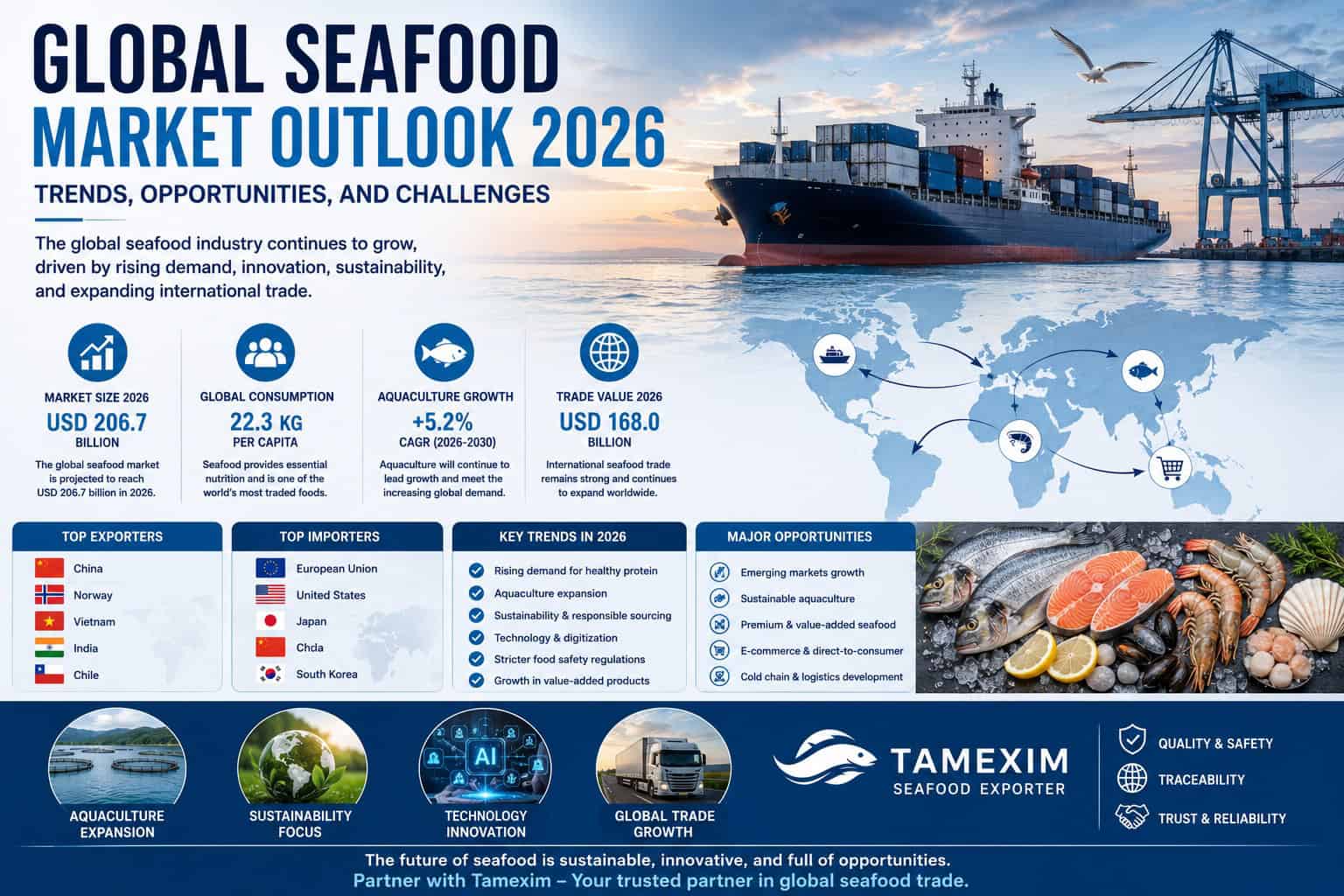
Global Seafood Market Outlook 2026: Trends, Opportunities, and Challenges
SEO Title: Global Seafood Market Outlook 2026 | Trends, Opportunities & Industry Analysis
Focus Keyword: Global Seafood Market
Meta Description: Explore the 2026 global seafood market outlook, including industry trends, leading exporters and importers, aquaculture growth, sustainability, and future opportunities for seafood businesses.
Global Seafood Market Outlook 2026: Trends, Opportunities, and Challenges
The global seafood industry continues to play a vital role in feeding a growing population while supporting international trade, employment, and economic development. Seafood remains one of the world’s most traded food commodities, connecting producers, processors, exporters, distributors, retailers, and consumers across every continent.
In 2026, the industry is experiencing significant transformation. Rising consumer demand for healthy protein, advances in aquaculture, increasing sustainability expectations, digital supply chain technologies, and evolving food safety regulations are reshaping global seafood trade.
At the same time, exporters face new challenges including climate change, transportation costs, geopolitical uncertainty, labor shortages, and stricter import regulations. Companies that adapt quickly to these changes will be better positioned to compete in international markets.
This report provides a comprehensive overview of the global seafood market in 2026, highlighting emerging trends, major producing countries, leading import markets, growth opportunities, and future industry developments.
Overview of the Global Seafood Industry
Seafood is one of the fastest-growing food sectors worldwide. Fish, shrimp, shellfish, mollusks, and other aquatic products provide high-quality protein and essential nutrients for billions of people.
The industry includes:
Wild capture fisheries
Aquaculture
Seafood processing
Cold chain logistics
International trade
Retail and food service
Value-added seafood manufacturing
Global demand continues to increase due to population growth, urbanization, changing dietary habits, and greater awareness of the health benefits associated with seafood consumption.
Key Drivers of Market Growth
Several factors continue to support long-term growth in the seafood industry.
Growing Global Population
The world’s population continues to increase, creating higher demand for nutritious and sustainable protein sources.
Seafood offers:
High-quality protein
Omega-3 fatty acids
Vitamins and minerals
Lower environmental impact than many land-based protein sources
These characteristics make seafood an increasingly attractive option for consumers and governments alike.
Expansion of Aquaculture
Aquaculture has become one of the fastest-growing food production sectors in the world.
Modern fish and shrimp farming now supplies a substantial share of the seafood consumed globally.
Growth has been supported by:
Improved genetics
Better feed technology
Disease management
Water quality monitoring
Automated farming systems
Sustainable production methods
As wild fish stocks face increasing pressure, aquaculture is expected to play an even greater role in meeting future demand.
Rising Consumer Interest in Healthy Foods
Consumers are becoming more health-conscious and are actively seeking foods that support cardiovascular health, brain function, and overall wellness.
Seafood is widely recognized for its nutritional value because it contains:
Lean protein
Essential amino acids
Vitamin D
Selenium
Iodine
EPA and DHA omega-3 fatty acids
This trend continues to increase seafood consumption across developed and emerging markets.
Major Seafood Producing Regions
Seafood production is concentrated in several regions with advanced fishing industries and aquaculture sectors.
Asia-Pacific
The Asia-Pacific region remains the largest seafood-producing area in the world.
Countries in this region benefit from:
Extensive coastlines
Strong aquaculture industries
Advanced seafood processing
Large domestic markets
Competitive production costs
The region also supplies a significant portion of globally traded shrimp, tilapia, carp, and various marine fish species.
Europe
European producers focus on high-value seafood products, advanced processing technologies, and strict food safety standards.
The region is also a major importer due to strong consumer demand that exceeds domestic production.
North America
North America maintains an important role in seafood harvesting, processing, innovation, and international trade.
The region imports substantial volumes of seafood while exporting premium products such as lobster, salmon, crab, and shellfish.
Middle East
Demand for imported seafood continues to grow across the Gulf region.
Population growth, tourism, expanding hospitality industries, and changing dietary preferences are increasing seafood consumption in countries such as the United Arab Emirates, Saudi Arabia, Qatar, and Kuwait.
For exporters, these markets offer significant long-term opportunities.
The World’s Leading Seafood Exporters
Several countries dominate international seafood exports due to strong production capacity, advanced infrastructure, and well-established trade networks.
Leading exporting nations include:
China
Norway
Vietnam
India
Chile
Ecuador
Russia
Canada
Thailand
Indonesia
Each country specializes in different seafood products, ranging from salmon and shrimp to whitefish, tuna, and shellfish.
Successful exporters invest heavily in food safety systems, cold chain logistics, sustainability programs, and international certifications.
The Largest Seafood Import Markets
International demand is concentrated in several high-value regions.
Major importing markets include:
European Union
United States
Japan
China
South Korea
United Arab Emirates
Saudi Arabia
United Kingdom
Canada
Australia
These markets generally require strict compliance with food safety regulations, traceability systems, quality standards, and accurate labeling.
Sustainability Continues to Shape the Market
Sustainability has evolved from a niche concern into a mainstream purchasing requirement.
Retailers, restaurants, and consumers increasingly prefer seafood sourced through responsible fishing and aquaculture practices.
Important sustainability priorities include:
Responsible fisheries management
Environmental protection
Sustainable aquaculture
Reduction of illegal fishing
Traceability
Reduced carbon footprint
Responsible packaging
Exporters that demonstrate sustainable practices often gain a competitive advantage in premium markets.
Technology Is Transforming the Seafood Industry
Digital technologies are changing how seafood is produced, processed, transported, and marketed.
Innovations include:
Artificial Intelligence (AI)
Internet of Things (IoT)
Smart aquaculture systems
Automated feeding technology
Blockchain traceability
Digital quality monitoring
Predictive analytics
Electronic export documentation
Technology improves efficiency, transparency, and food safety throughout the seafood supply chain.