
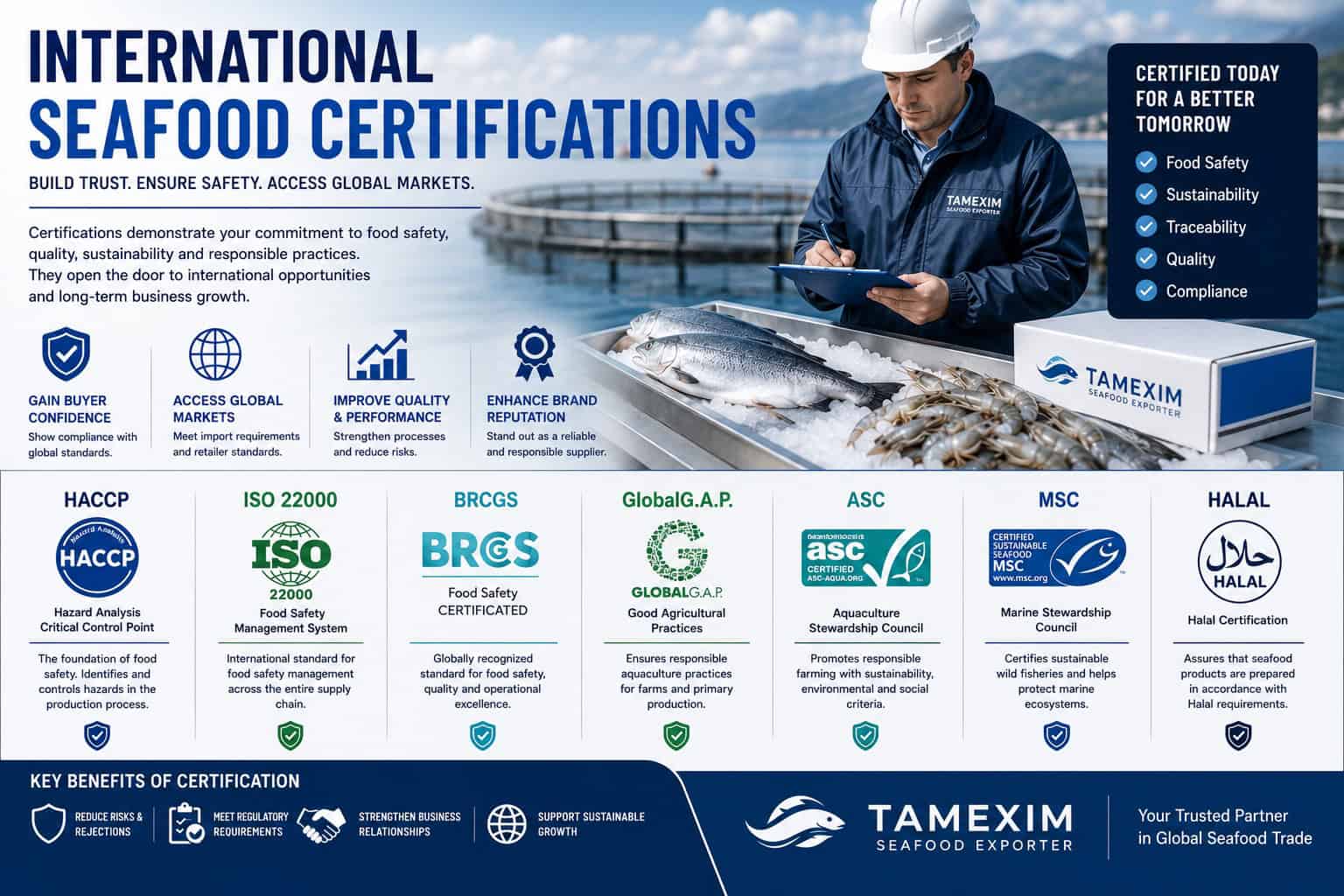
International Seafood Certifications: A Complete Guide for Seafood Exporters
SEO Title: International Seafood Certifications | Complete Guide for Seafood Exporters
Focus Keyword: International Seafood Certifications
Meta Description: Discover the most important international seafood certifications including HACCP, ISO 22000, BRCGS, MSC, ASC, GlobalG.A.P., and FDA requirements. Learn how certifications improve seafood export opportunities.
International Seafood Certifications: A Complete Guide for Seafood Exporters
International seafood buyers are becoming increasingly selective when choosing suppliers. Competitive pricing and high-quality products are no longer enough to secure long-term contracts. Importers also expect suppliers to demonstrate compliance with internationally recognized food safety, sustainability, and quality standards.
This is where international seafood certifications play a critical role. Certifications provide independent verification that seafood products are produced, processed, handled, and transported according to globally accepted requirements. They increase buyer confidence, simplify regulatory compliance, and improve access to premium markets.
Whether exporting farmed shrimp, salmon, trout, carp, or wild-caught seafood, understanding certification requirements is essential for long-term success in international trade.
Why Seafood Certifications Matter
Seafood certifications provide assurance that products meet internationally accepted standards for safety, quality, sustainability, and traceability.
For exporters, certification offers several important advantages:
Improved credibility with international buyers
Easier market access
Reduced inspection risks
Better food safety management
Stronger brand reputation
Competitive differentiation
Increased customer confidence
Support for long-term export growth
Many global retailers require suppliers to hold specific certifications before approving them.
HACCP Certification
Hazard Analysis and Critical Control Point (HACCP) is considered the foundation of modern seafood food safety.
Rather than relying on end-product testing alone, HACCP identifies hazards throughout the production process and establishes preventive controls.
Key benefits include:
Hazard prevention
Process monitoring
Improved product safety
Regulatory compliance
Reduced recalls
Greater buyer confidence
Although HACCP itself is a management system, documented implementation is a prerequisite for many international markets.
ISO 22000
ISO 22000 is an internationally recognized Food Safety Management System (FSMS) standard.
It combines:
HACCP principles
Risk-based thinking
Management system requirements
Continuous improvement
Communication throughout the food chain
ISO 22000 applies to organizations involved in every stage of the food supply chain, including seafood farms, processors, cold storage facilities, logistics providers, and exporters.
Benefits include:
Structured food safety management
International recognition
Better operational control
Increased customer trust
Easier compliance with regulations
BRCGS Global Food Safety Standard
The BRCGS Global Food Safety Standard is widely recognized by retailers in the United Kingdom, Europe, North America, and many international markets.
The standard evaluates:
Food safety
Quality management
Facility conditions
Employee hygiene
Production control
Product authenticity
Documentation
Many supermarket chains require suppliers to hold BRCGS certification before purchasing products.
GlobalG.A.P.
GlobalG.A.P. focuses primarily on primary production, including aquaculture.
For seafood farms, the standard emphasizes:
Responsible farming practices
Animal welfare
Environmental protection
Worker health and safety
Responsible use of veterinary medicines
Record keeping
GlobalG.A.P. certification helps demonstrate responsible production before seafood enters processing facilities.
Aquaculture Stewardship Council (ASC)
ASC certification applies to responsibly farmed seafood.
The standard evaluates:
Environmental sustainability
Responsible feed management
Water quality
Biodiversity protection
Social responsibility
Worker welfare
Community engagement
ASC-certified products are increasingly preferred by retailers seeking sustainable seafood.
Marine Stewardship Council (MSC)
MSC certification applies to wild-caught fisheries.
It focuses on:
Sustainable fish stocks
Responsible fishing practices
Ecosystem protection
Effective fisheries management
Independent auditing
Products carrying the MSC label provide assurance that seafood originates from responsibly managed fisheries.
FDA Seafood Requirements
Seafood exported to the United States must comply with FDA food safety regulations.
Exporters should ensure:
HACCP implementation
Proper labeling
Sanitary processing
Traceability documentation
Supplier verification
Regulatory compliance
Failure to meet FDA requirements may result in shipment detention or refusal of entry.
European Union Requirements
The European Union maintains some of the world’s most comprehensive seafood import requirements.
Key expectations include:
Approved processing establishments
Health certificates
HACCP implementation
Product traceability
Veterinary inspections
Residue monitoring
Correct labeling
Compliance improves access to one of the largest seafood markets in the world.
Halal Certification
For exports to many Middle Eastern and Muslim-majority countries, Halal certification may be an important commercial requirement.
Halal certification demonstrates that seafood products and processing practices comply with recognized Islamic standards where applicable.
Comparing Major Seafood Certifications
| Certification | Primary Focus | Typical Users |
|---|---|---|
| HACCP | Food safety hazard control | Processors & exporters |
| ISO 22000 | Food safety management system | Entire food chain |
| BRCGS | Retail food safety & quality | Exporters & manufacturers |
| GlobalG.A.P. | Responsible aquaculture | Fish & shrimp farms |
| ASC | Sustainable aquaculture | Aquaculture producers |
| MSC | Sustainable wild fisheries | Fishing companies |
| Halal | Religious compliance | Exporters to Halal markets |
How Exporters Can Prepare for Certification
Companies planning to obtain certification should:
Develop documented procedures.
Train employees regularly.
Maintain accurate production records.
Implement internal audits.
Improve traceability systems.
Verify supplier compliance.
Monitor corrective actions.
Continuously review food safety performance.
Preparation significantly improves audit success.
Frequently Asked Questions
Which certification is most important for seafood exporters?
The answer depends on the target market. However, HACCP is generally considered the foundation of seafood food safety, while ISO 22000, BRCGS, ASC, MSC, and GlobalG.A.P. may be required depending on the product and destination.
Can a company hold multiple certifications?
Yes. Many successful seafood exporters maintain several certifications to satisfy different customers and market requirements.
Do certifications improve export opportunities?
Absolutely. Certified suppliers are often preferred by international buyers because certifications reduce risk and demonstrate commitment to quality and food safety.
Are certifications mandatory?
Some certifications are legally required in specific markets, while others are commercial requirements imposed by buyers or retailers.
Conclusion
International seafood certifications have become essential tools for building trust in global seafood trade. They demonstrate that products are produced responsibly, processed safely, and managed according to internationally recognized standards.
For seafood exporters, investing in certification is more than a regulatory exercise. It is a strategic decision that strengthens market access, improves operational performance, enhances buyer confidence, and supports long-term business growth.
As international food safety expectations continue to evolve, companies that embrace recognized certification programs will be better positioned to compete successfully in global seafood markets.