
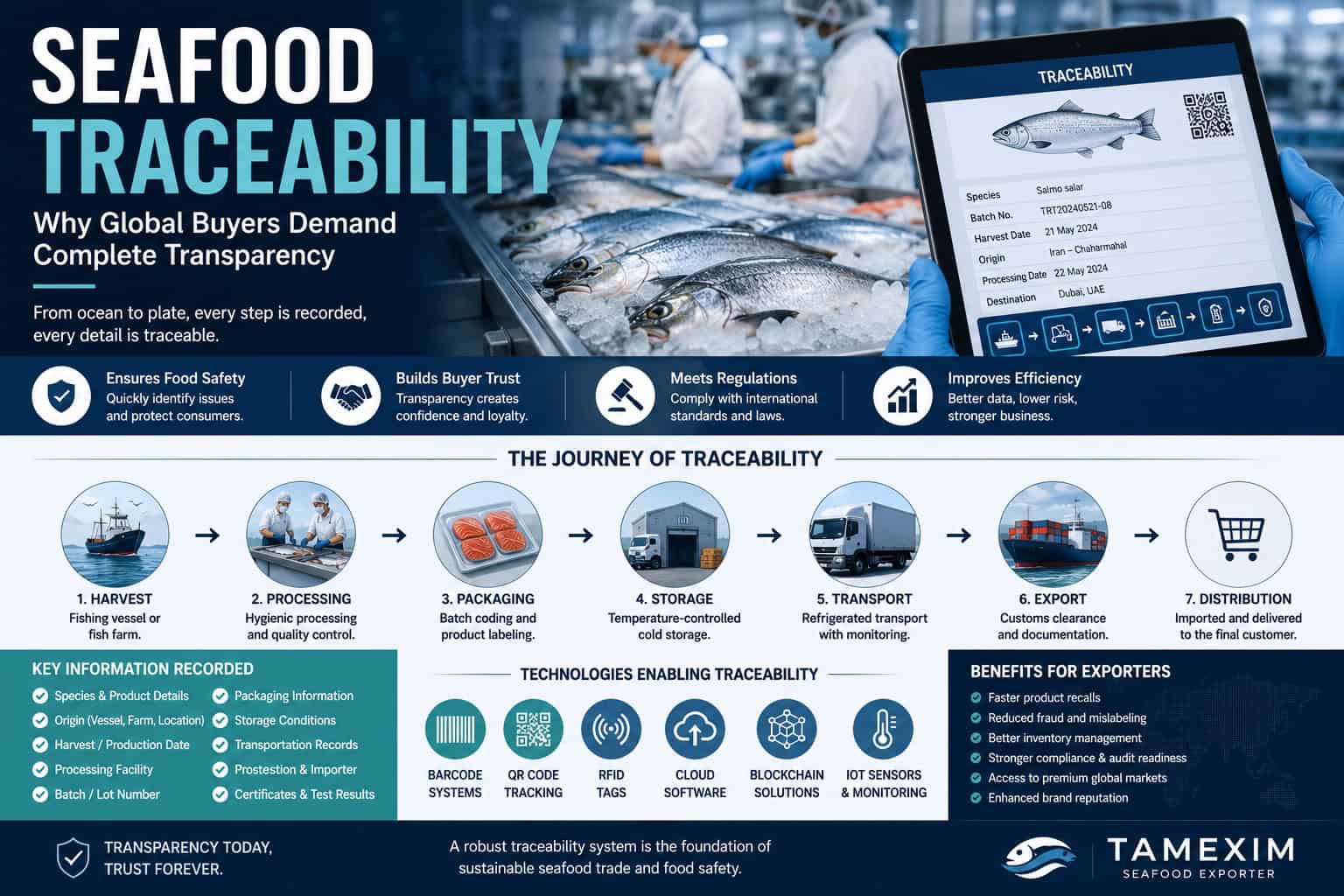
Seafood Traceability: Why Global Buyers Demand Complete Transparency
SEO Title: Seafood Traceability | Why Global Buyers Require Full Supply Chain Transparency
Focus Keyword: Seafood Traceability
Meta Description: Learn why seafood traceability is essential for international trade, food safety, regulatory compliance, and buyer confidence. Discover how traceability systems improve seafood exports.
Seafood Traceability: Why Global Buyers Demand Complete Transparency
In today’s global seafood industry, buyers expect much more than high-quality products. They want transparency, accountability, and confidence that every shipment can be traced back to its origin. Seafood traceability has become one of the most important requirements for international trade, helping importers verify product authenticity, ensure food safety, and comply with increasingly strict regulations.
Whether seafood is wild-caught or farm-raised, every stage of the supply chain should be documented. From harvesting and processing to packaging, storage, transportation, and final delivery, traceability allows businesses to identify where a product came from, how it was handled, and whether it meets international standards.
For seafood exporters, implementing an effective traceability system is no longer just a competitive advantage. It has become a business necessity.
What Is Seafood Traceability?
Seafood traceability is the ability to track and trace seafood products throughout the entire supply chain.
A complete traceability system records information from:
Fish farm or fishing vessel
Harvest date
Species identification
Processing facility
Batch number
Packaging
Cold storage
Transportation
Import and distribution
Each shipment should have sufficient documentation to identify its complete production history.
Why Traceability Matters
Traceability protects everyone involved in the seafood supply chain.
For consumers, it provides confidence that seafood is safe and legally sourced.
For importers, it reduces business risks and simplifies supplier verification.
For exporters, it strengthens credibility and improves access to international markets.
Major benefits include:
Improved food safety
Faster product recalls
Reduced fraud
Better inventory management
Regulatory compliance
Increased buyer confidence
Protection of brand reputation
Companies with effective traceability systems often gain long-term relationships with international buyers.
How a Seafood Traceability System Works
Every batch of seafood receives a unique identification number that follows the product throughout its journey.
Typical recorded information includes:
| Stage | Information Recorded |
|---|---|
| Harvest | Date, location, vessel or farm |
| Processing | Facility, production line, processing date |
| Packaging | Batch number, packaging date |
| Storage | Temperature records, warehouse location |
| Transportation | Container number, shipping documents |
| Distribution | Importer, distributor, retailer |
This information enables rapid identification if any food safety issue occurs.
Key Components of an Effective Traceability System
An effective seafood traceability program includes:
Product Identification
Each product should be clearly identified by:
Scientific species name
Commercial name
Batch number
Production date
Expiration date
Unique identifiers reduce confusion and improve inventory accuracy.
Batch Coding
Batch codes link products to production records.
If a problem is detected, only affected batches need to be recalled rather than the entire production.
This significantly reduces financial losses.
Digital Record Keeping
Modern exporters increasingly replace paper documentation with digital systems.
Electronic records improve:
Accuracy
Accessibility
Data security
Audit readiness
Regulatory compliance
Cloud-based software also allows faster communication between suppliers and buyers.
Traceability and Food Safety
Traceability plays a critical role in food safety management.
If laboratory testing detects contamination, traceability helps identify:
The affected production batch
The processing date
The raw material source
Distribution channels
Customers who received the product
Rapid identification allows businesses to respond quickly and minimize public health risks.
International Regulations
Many importing countries require documented seafood traceability.
Examples include:
European Union
The EU requires seafood products to include detailed catch or farming information, processing records, and labeling that supports full traceability throughout the supply chain.
United States
Seafood imported into the United States must comply with FDA regulations, and certain products are also subject to enhanced traceability requirements designed to combat illegal, unreported, and unregulated (IUU) fishing.
Gulf Countries
Many Gulf Cooperation Council (GCC) countries increasingly expect exporters to provide complete documentation covering product origin, health certification, labeling, and cold chain records.
Technologies Supporting Traceability
Modern seafood companies use advanced technologies to improve transparency.
Common tools include:
Barcode systems
QR codes
RFID tags
Enterprise Resource Planning (ERP) software
GPS vessel monitoring
IoT sensors
Blockchain platforms
These technologies reduce manual errors and improve data reliability across the supply chain.
Seafood Fraud and Traceability
Seafood fraud remains a major challenge in international trade.
Common examples include:
Species substitution
False origin claims
Mislabeling
Illegal fishing
Counterfeit certification
Traceability systems help prevent fraud by providing verifiable records at every stage of production and distribution.
Best Practices for Seafood Exporters
Exporters should:
Maintain complete production records.
Label every batch clearly.
Verify supplier information.
Conduct regular internal audits.
Train employees on documentation procedures.
Preserve cold chain records.
Keep laboratory test reports.
Review traceability procedures regularly.
Strong documentation improves both operational efficiency and buyer confidence.
Frequently Asked Questions
What is seafood traceability?
Seafood traceability is the ability to track seafood products from harvest or aquaculture through processing, transportation, distribution, and final sale.
Why do buyers require traceability?
Traceability improves food safety, supports regulatory compliance, reduces fraud, and enables rapid product recalls when necessary.
Is traceability mandatory?
In many international markets, yes. Regulations vary by country, but traceability is increasingly required for imported seafood.
How does traceability benefit exporters?
It strengthens buyer confidence, simplifies audits, supports food safety programs, and improves access to premium export markets.
Conclusion
Seafood traceability has become a cornerstone of modern seafood trade. Buyers no longer evaluate suppliers based solely on price or product quality. They expect transparency, accurate documentation, and the ability to verify every stage of the supply chain.
Exporters that invest in robust traceability systems are better equipped to meet international regulations, reduce operational risks, protect their reputation, and build long-term partnerships with global customers.
As seafood markets continue to evolve, traceability will remain one of the strongest indicators of professionalism, reliability, and commitment to food safety.