
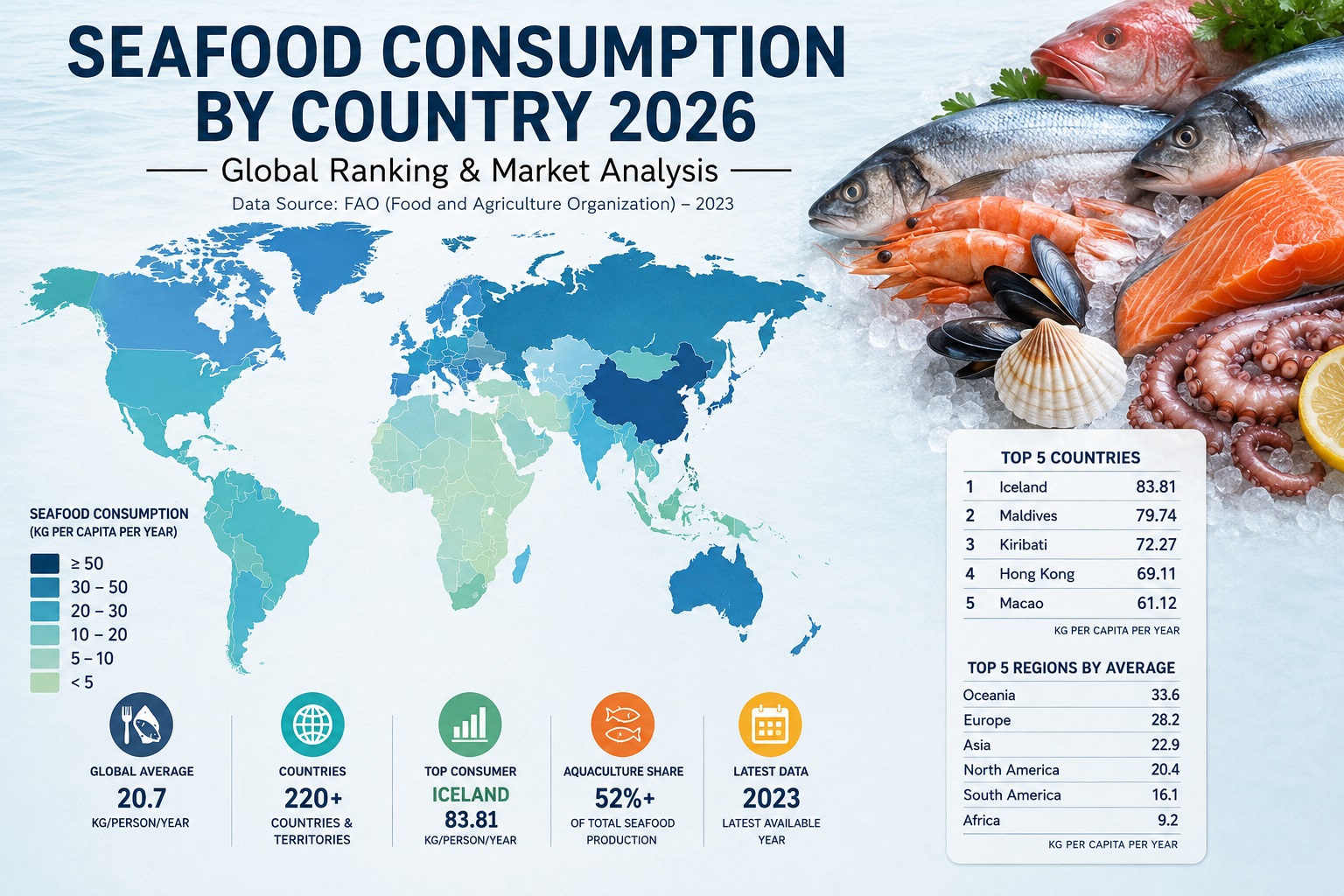
Seafood Consumption by Country (2026 Global Ranking)
A Comprehensive Analysis of Global Seafood Consumption, Market Trends, and International Trade Opportunities
Executive Summary
Seafood has become one of the fastest-growing food categories worldwide. Rising health awareness, increasing disposable income, population growth, and rapid expansion of aquaculture have significantly increased global seafood consumption over the past six decades.
According to the latest FAO data, the average global seafood supply has reached approximately 20.7 kilograms per person per year, more than doubling compared to the early 1960s. Today, seafood provides a major source of animal protein for billions of people worldwide, while aquaculture has become the primary contributor to global seafood production.
This report analyzes seafood consumption across more than 220 countries and territories, identifies the world’s largest seafood-consuming nations, examines regional consumption patterns, and highlights promising international seafood markets for exporters and importers.
Key Highlights
- Global Average Consumption: 20.7 kg per capita annually
- Data Coverage: 220+ Countries & Territories
- Latest Available Year: 2023
- Data Source: FAO Food Balance Sheets
- Processed by: Our World in Data
- Update Frequency: Annual
Why Seafood Consumption Matters
Seafood consumption is more than a dietary preference. It reflects economic development, cultural traditions, geographic accessibility, public health awareness, and the strength of a country’s fisheries and aquaculture sectors.
Countries with high seafood consumption often demonstrate:
- Strong fishing industries
- Advanced aquaculture production
- Higher demand for premium seafood
- Well-developed cold-chain logistics
- Large seafood import markets
- Greater opportunities for international exporters
Understanding these consumption patterns enables seafood businesses to identify attractive export destinations and develop more effective market-entry strategies.
Global Seafood Consumption Ranking (Top 25)
| Rank | Country | Region | Consumption (kg/person/year) |
|---|---|---|---|
| 1 | Iceland | Europe | 83.81 |
| 2 | Maldives | Asia | 79.74 |
| 3 | Kiribati | Oceania | 72.27 |
| 4 | Hong Kong | Asia | 69.11 |
| 5 | Macao | Asia | 61.12 |
| 6 | Micronesia (FAO) | Oceania | 58.40 |
| 7 | Tuvalu | Oceania | 55.82 |
| 8 | Antigua and Barbuda | Caribbean | 54.51 |
| 9 | Portugal | Europe | 53.49 |
| 10 | South Korea | Asia | 52.82 |
| 11 | Malaysia | Asia | 51.03 |
| 12 | French Polynesia | Oceania | 50.51 |
| 13 | Norway | Europe | 49.10 |
| 14 | Micronesia | Oceania | 48.98 |
| 15 | Samoa | Oceania | 46.62 |
| 16 | Marshall Islands | Oceania | 44.55 |
| 17 | Barbados | Caribbean | 43.16 |
| 18 | Seychelles | Africa | 42.91 |
| 19 | China | Asia | 41.68 |
| 20 | Indonesia | Asia | 40.42 |
| 21 | Spain | Europe | ~40 |
| 22 | Japan | Asia | ~39 |
| 23 | Vietnam | Asia | ~38 |
| 24 | Taiwan | Asia | ~37 |
| 25 | France | Europe | ~34 |
Values are based on the latest available FAO food supply dataset for 2023. Some values are rounded for readability.
Why Do These Countries Consume More Seafood?
The world’s leading seafood-consuming countries share several characteristics:
1. Geography
Island nations such as Iceland, the Maldives, Kiribati, and Tuvalu have direct access to abundant marine resources. Seafood has traditionally been a staple food because fishing is deeply integrated into daily life and local economies.
2. Cultural Heritage
Countries such as Japan, South Korea, Portugal, and Spain have centuries-old culinary traditions centered around seafood. Fish, shellfish, squid, octopus, and crustaceans remain essential components of their national cuisines.
3. Strong Aquaculture Industries
China, Indonesia, Vietnam, and Malaysia have invested heavily in aquaculture, allowing them to increase domestic seafood availability while supporting export growth.
4. Health Awareness
Consumers increasingly recognize seafood as an excellent source of lean protein, omega-3 fatty acids, vitamins, and minerals. This has contributed to sustained growth in seafood demand across developed and emerging markets.
Global Consumption Trends
Global seafood consumption has increased consistently over the past six decades.
Key drivers include:
- Population growth
- Rising incomes
- Urbanization
- Expansion of aquaculture
- Improved cold-chain logistics
- International seafood trade
- Increased awareness of healthy diets
Aquaculture now supplies more than half of all seafood consumed globally, marking a historic shift in the global food system.
Business Insights for Seafood Exporters
Countries with high per-capita seafood consumption often represent attractive export opportunities.
High-Potential Markets
★★★★★
- China
- South Korea
- Japan
- Portugal
- Spain
- United Arab Emirates
- Saudi Arabia
- Qatar
- Norway
These markets generally demand:
- Frozen seafood
- Premium salmon
- Rainbow trout
- Shrimp
- Value-added seafood products
- Reliable cold-chain logistics
- International food safety certifications
While the world’s top 25 seafood-consuming countries receive most of the attention, the nations ranked between 26 and 100 represent some of the most attractive and fastest-growing seafood markets. These countries combine stable consumer demand, expanding middle-class populations, increasing health awareness, and strong import requirements.
For seafood exporters, these markets often provide better long-term business opportunities than highly saturated premium markets.
Europe
Several European countries continue to maintain high seafood consumption due to long coastal traditions and Mediterranean diets.
Important Markets
- Italy
- Denmark
- Finland
- Ireland
- United Kingdom
- Netherlands
- Belgium
- Greece
- Croatia
Market Characteristics
- High demand for salmon
- Growing interest in premium frozen seafood
- Strong sustainability requirements
- Strict food safety regulations
- Preference for certified suppliers
Middle East
The Middle East has become one of the fastest-growing seafood import regions.
Major Markets
- United Arab Emirates
- Saudi Arabia
- Qatar
- Kuwait
- Bahrain
- Oman
Market Trends
- Rapid population growth
- Expanding hospitality sector
- Premium retail demand
- Increasing seafood consumption
- Heavy dependence on imports
Products in high demand include:
- Atlantic Salmon
- Rainbow Trout
- Vannamei Shrimp
- Sea Bass
- Sea Bream
East Asia
East Asia remains one of the world’s largest seafood-consuming regions.
Important markets include:
- Taiwan
- Singapore
- Thailand
Consumers prefer:
- Fresh seafood
- Live seafood
- Premium frozen products
- Value-added seafood
Southeast Asia
Although many Southeast Asian countries are major seafood producers, imports continue to grow due to increasing domestic demand.
Key markets include:
- Thailand
- Philippines
- Brunei
- Cambodia
Growing demand:
- Shrimp
- Salmon
- Tuna
- Frozen fish fillets
North America
The United States and Canada continue to increase seafood imports each year.
Consumer preferences include:
- Healthy protein
- Ready-to-cook products
- Sustainable seafood
- Certified seafood
Popular products include:
- Salmon
- Shrimp
- Lobster
- Crab
- Cod
Latin America
Important markets:
- Chile
- Brazil
- Argentina
- Uruguay
Demand continues to increase for:
- Premium seafood
- Frozen products
- Processed seafood
Africa
Although average seafood consumption is lower than many other regions, several countries show strong growth potential.
Growing markets include:
- Morocco
- Egypt
- Tunisia
- South Africa
- Mauritius
Population growth and expanding retail sectors continue to support seafood demand.
Oceania
Besides Australia and New Zealand, many Pacific Island nations maintain relatively high seafood consumption because of their geography and fishing traditions.
Emerging Seafood Markets
Several countries are expected to experience significant growth over the next decade.
High Growth Potential
- India
- Indonesia
- Vietnam
- Saudi Arabia
- United Arab Emirates
- Egypt
- Nigeria
- Brazil
Key drivers include:
- Urbanization
- Income growth
- Health awareness
- Expansion of supermarket chains
- Cold-chain development
What Drives Seafood Consumption?
Seafood consumption is influenced by several interconnected factors:
Geography
Countries with long coastlines and abundant marine resources naturally consume more seafood.
Income
Higher disposable income allows consumers to purchase premium seafood products more frequently.
Culture
Traditional cuisines strongly influence seafood demand. Nations such as Japan, Portugal, Spain, and South Korea have deep-rooted seafood cultures.
Aquaculture
Countries with advanced aquaculture industries generally have higher seafood availability and consumption.
Health Awareness
As consumers seek healthier diets, seafood continues to replace red meat in many regions.
Business Opportunities for Exporters
For seafood exporters, countries ranked between 26 and 100 often provide an excellent balance between demand and competition.
These markets typically offer:
- Stable import demand
- Lower market saturation
- Growing middle-class consumers
- Expanding food service industries
- Increasing supermarket penetration
Products with Strong Global Demand
Across these markets, several products consistently perform well:
- Atlantic Salmon
- Rainbow Trout
- Vannamei Shrimp
- Black Tiger Shrimp
- Tilapia
- Sea Bass
- Sea Bream
- Tuna
- Cod
- Mackerel
Key Takeaways
- Countries outside the global top 25 still represent substantial seafood import opportunities.
- Rapid economic development and changing consumer preferences continue to drive seafood demand worldwide.
- Exporters that offer certified products, reliable cold-chain logistics, and consistent quality are well positioned for long-term success.
- Diversifying export destinations can reduce market risk and create sustainable growth opportunities.